
Do TENS Units Help With Recovery? Benefits, Limits, and Safe Use
Learn whether TENS supports pain relief during recovery, what evidence says about DOMS and muscle repair, and how it fits with physiotherapy.
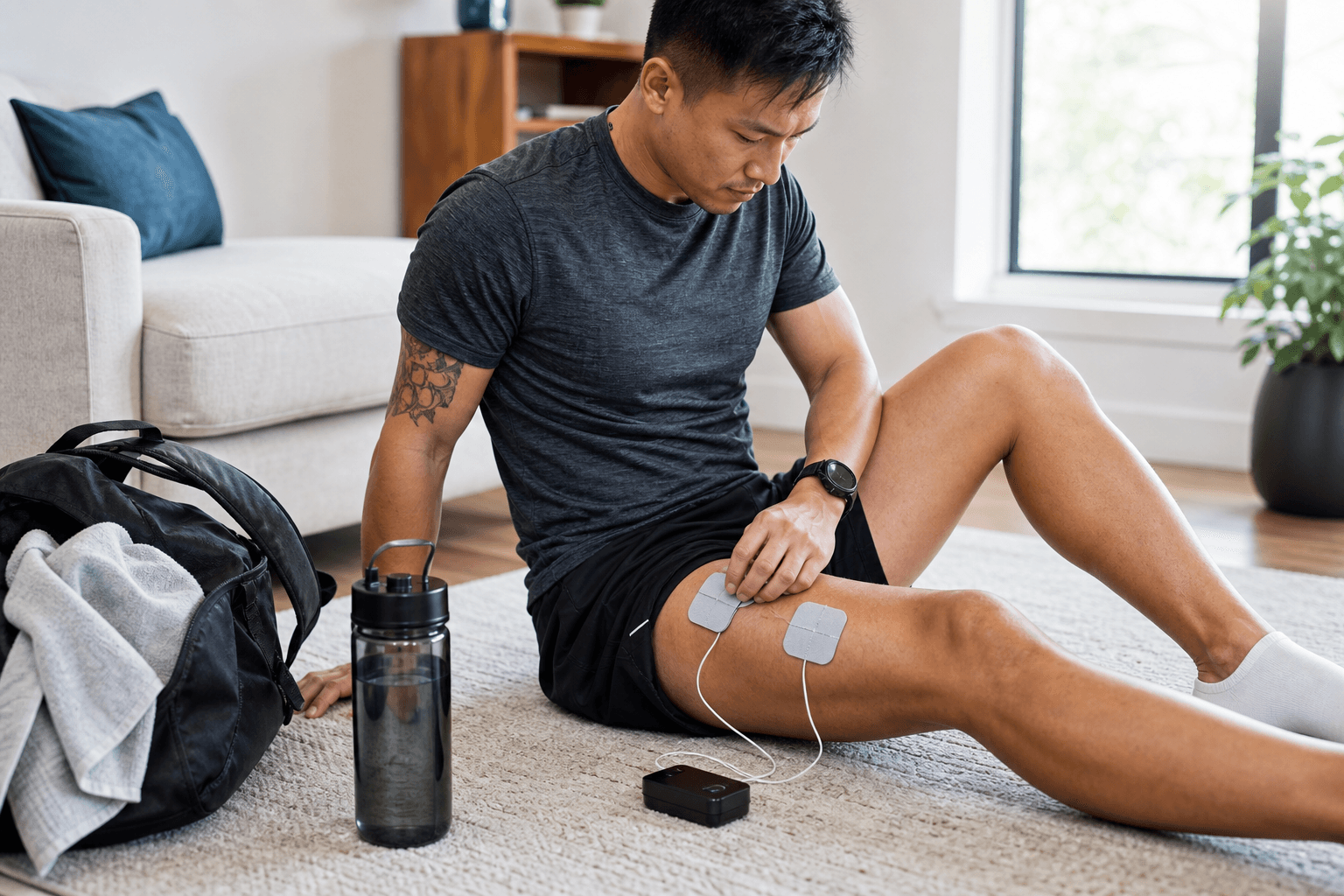
If you are considering a TENS unit for recovery, the most accurate answer is nuanced: it may help some people manage pain during movement or rehabilitation, but it is not established as a reliable way to repair muscle faster, prevent delayed-onset muscle soreness (DOMS), or improve athletic performance.
TENS is best viewed as a possible pain-management tool that supports an existing recovery plan, not a replacement for assessment, progressive exercise, or treatment of the underlying problem.
Quick summary
- TENS may provide temporary pain relief for some people, including during activity or rehabilitation.
- Evidence is weak or inconclusive for preventing DOMS, accelerating muscle recovery, or improving later exercise performance.
- A TENS unit should complement movement, education, strengthening, and other rehabilitation.
- Before using one at home, clarify your goal, learn electrode placement, and confirm that it fits your care plan.
What TENS can and cannot do
Transcutaneous electrical nerve stimulation, or TENS, uses a small device and surface electrodes to deliver mild electrical pulses through the skin. People commonly consider it for pain relief, muscle tension, or discomfort between rehabilitation appointments.
If pain makes it difficult to walk, complete prescribed exercises, or take part in normal activities, reducing discomfort may help you participate more comfortably. However, feeling less pain does not necessarily mean an injury has healed or that tissue is recovering faster.
TENS is also different from electrical stimulation designed to create muscle contractions. Because these terms are sometimes used loosely, ask which mode is being recommended and why.
TENS recovery benefits: how the evidence compares
The value of TENS depends on what you mean by recovery. Pain relief during rehabilitation is a different outcome from faster muscle repair or improved sports performance.
| Recovery goal | What the evidence suggests | Practical expectation |
|---|---|---|
| Pain during activity | Possible benefit for some people when TENS is used with activity or exercise. | It may make movement more tolerable, but responses vary. |
| Injury-related pain | It may support short-term pain management but does not identify or correct the cause. | Use symptom relief as part of broader rehabilitation. |
| Delayed-onset muscle soreness | Evidence does not reliably show that electrical stimulation prevents or treats DOMS. | Do not expect it to eliminate post-workout soreness. |
| Muscle repair | TENS has not been established as a dependable way to speed tissue healing. | Appropriate loading, rest, and clinical care remain important. |
| Later exercise performance | Evidence is not convincing that electrical stimulation improves subsequent performance. | It is not a proven performance-enhancement strategy. |
Systematic reviews have found low- to very-low-quality evidence that electrical stimulation prevents or treats DOMS or improves muscle recovery after exercise. Another review found no convincing support for improving subsequent performance, although some participants reported subjective recovery benefits. See the review of electrical stimulation and DOMS and the review of neuromuscular electrical stimulation during recovery.
When TENS may be useful during recovery
TENS may be worth considering when your main goal is managing pain so you can take part in appropriate movement or rehabilitation. For example, someone with activity-related pain may use it alongside mobility work, strengthening, pacing, and education.
It may also be useful between clinic visits when a healthcare professional has explained the device and how it fits your plan. The aim is not to mask symptoms so you can push through worsening pain. It is to support safe participation in activities already judged appropriate.
Planet Health Care offers TENS units and recovery products, with guidance on choosing a unit, setting it up, and understanding electrode placement for at-home pain management. Product guidance is not a diagnosis, so persistent or changing symptoms still warrant assessment.
TENS for post-exercise soreness and muscle recovery
Post-exercise soreness is a common reason people search for TENS recovery benefits. Feeling less sore is not the same as measurable improvement in muscle recovery, strength, or performance.
Current evidence does not support presenting TENS as a dependable way to prevent DOMS or accelerate recovery after a demanding workout. It may change how discomfort feels for some users, but that does not prove the muscle has repaired faster or that you are ready for harder training.
If soreness is mild and follows a familiar training load, gradual movement and sensible progression may be appropriate. Sharp, unusual, worsening, or recurring pain should not be managed only with a TENS unit.
What to consider before choosing or using a TENS unit
Start with the outcome you want. A unit may be more relevant to managing pain during prescribed exercises than to claims about faster muscle repair.
Questions to ask before buying
- What problem am I trying to manage, and has it been assessed?
- Is this device intended for pain management, muscle stimulation, or both?
- Will someone show me electrode placement for my area and goal?
- How should the intensity feel, and what should I do if symptoms increase?
- Can the device fit with my current exercise or rehabilitation plan?
- What signs mean I should stop and seek advice?
Comfort and correct placement matter. Follow the device instructions and any condition-specific guidance. Avoid improvising a setup from a generic diagram, particularly near a surgical site or when the cause of pain is uncertain.
How TENS fits alongside physiotherapy
When appropriate, TENS is one supportive modality within a wider plan. Physiotherapy may address movement limitations, strength, load tolerance, technique, and contributing factors. A device can sometimes improve comfort, but it does not provide that assessment or progression.
Using TENS to make an exercise more tolerable may help, but increasing activity simply because pain is reduced could overload healing tissue.
A physiotherapy assessment can help determine whether TENS or other EMS/TENS modalities are appropriate alongside hands-on treatment, education, exercise, and a customized home program. Research on TENS during functional activity suggests possible benefits for people with pain, while noting that stronger trials are needed. See the review of TENS during activity and exercise.
When to ask a healthcare professional first
Ask for individualized guidance if you are unsure what is causing your pain, recently had surgery, are recovering from a significant injury, or have worsening symptoms that interfere with normal function. Professional input is also sensible when electrode placement is unclear or you already have a rehabilitation plan.
Stop and seek appropriate advice if the device causes a marked increase in pain, feels unexpectedly uncomfortable, or leaves you uncertain about your symptoms. A clinician can decide whether TENS is suitable or whether another assessment matters more.
Coverage depends on the medical circumstances and benefit plan. Ontario’s disability-support schedule identifies TENS devices for certain qualifying conditions, including some post-procedure circumstances and forms of chronic, intractable pain. This does not mean every person or private plan is eligible, so confirm requirements before assuming reimbursement. See Ontario’s medical-device eligibility information.
A simple TENS buying and use checklist
- Define the goal. Choose pain management or activity support rather than expecting faster muscle repair.
- Check the underlying problem. Persistent or recurring pain deserves assessment.
- Learn the setup. Confirm electrode placement, intensity, session instructions, and expected sensations.
- Fit it into rehabilitation. Use it alongside appropriate movement, strengthening, pacing, and home exercises.
- Track the response. Notice whether it improves safe participation, not only whether it changes pain.
- Reassess if progress stalls. Ongoing pain or reduced function may require a revised plan.
Frequently asked questions
Can TENS prevent or reduce delayed-onset muscle soreness after exercise?
It should not be relied on to prevent or treat DOMS. Research is low or very low certainty, so a short-term change in soreness does not demonstrate faster recovery.
Does TENS build muscle or speed muscle repair?
TENS is primarily a pain-management tool. It has not been established as a reliable method for building muscle or speeding tissue repair.
Can TENS replace physiotherapy during injury recovery?
No. It may support comfort, but it does not replace assessment, exercise prescription, movement retraining, education, or progress monitoring.
Should I ask a physiotherapist before using TENS at home?
Yes, especially after an injury or surgery, with persistent symptoms, uncertain electrode placement, or an existing rehabilitation plan. A physiotherapist can help determine whether TENS fits your goals.
The bottom line on TENS and recovery
TENS recovery benefits are most realistic when the goal is temporary pain management that helps you participate in suitable activity or rehabilitation. The evidence does not justify treating TENS as a shortcut to muscle repair, DOMS prevention, or improved athletic performance.
If you are in London, Ontario and want help choosing a TENS unit, understanding electrode placement, or deciding whether it fits a physiotherapy-based plan, Planet Health Care offers product guidance and physiotherapy assessment at its North London clinic, with direct billing available to many major insurers.