
Tennis elbow shockwave: what can I expect from treatment?
Practical steps for tennis elbow shockwave: who is a candidate, what to expect during radial shockwave sessions, safety notes, evidence and booking.
Tennis elbow shockwave: what can I expect from treatment?
Quick answer: when shockwave therapy helps tennis elbow
If you have persistent lateral elbow tendinopathy that has not improved with exercises, activity modification or hands-on care, extracorporeal shockwave therapy (ESWT) can reduce pain and improve function for many people. Systematic reviews and meta-analyses report benefit in a number of trials, although protocols and outcomes vary between studies and not everyone responds.
Summary evidence:
- Shock wave therapy for lateral elbow pain — a broad review of trials and limitations.
- Clinical effectiveness of shockwave therapy in lateral elbow tendinopathy — a systematic review and meta-analysis summarizing pooled outcomes.
How shockwave therapy works and the main device types
Shockwave therapy delivers focused pulses of acoustic energy to tendon tissue. The intended effects include pain reduction, stimulation of a controlled healing response, tendon remodelling and improved local blood flow. Clinical devices use either focused or radial delivery. Trials that compared the two approaches for tennis elbow found both can reduce pain gradually, and radial shockwave is commonly used for superficial tendon problems such as lateral elbow tendinopathy.
For the focused versus radial comparison see: Focused and Radial Shock Wave Therapy in the Treatment of Tennis Elbow.
Am I a candidate? Screening, common contraindications and who benefits most
Clinicians usually consider shockwave when symptoms persist despite a reasonable trial of conservative care. Suitability is individual and based on history, examination and overall health.
- When to consider shockwave: ongoing pain with gripping or lifting, persistent tenderness at the lateral epicondyle and incomplete response to physiotherapy or home loading programs.
- Common contraindications checked before treatment: pregnancy, active infection at the treatment site, malignancy near the elbow, bleeding disorders or anticoagulant use that cannot be paused, and implanted electronic devices such as pacemakers in the treatment field.
- Relative exclusions: recent corticosteroid injection to the same area, uncontrolled systemic illness, or other conditions your clinician identifies during assessment.
Reviews summarise the screening used in trials and report generally low rates of significant adverse events when appropriate exclusions are applied (trial review).
Step-by-step: what happens at your first assessment and session
Planet Health Care follows an assessment-first pathway so the team can confirm diagnosis, rule out common mimics such as cervical or radial nerve irritation, and create a single coordinated plan that may combine shockwave with exercise, manual therapy or other modalities.
Pre-visit checklist
- Bring prior imaging or reports and a current medication list.
- Wear loose clothing that gives easy access to the elbow and forearm.
- Note which tasks cause pain and how symptoms have changed over time.
- Check your extended health coverage. Planet Health Care offers direct billing to many insurers, which can simplify payment.
- Free parking is available at the Sherwood Forest Mall entrance near the clinic.
Clinic information and booking: Shockwave therapy at Planet Health Care and Planet Health Care.
During the session: positioning, sensations and clinician steps
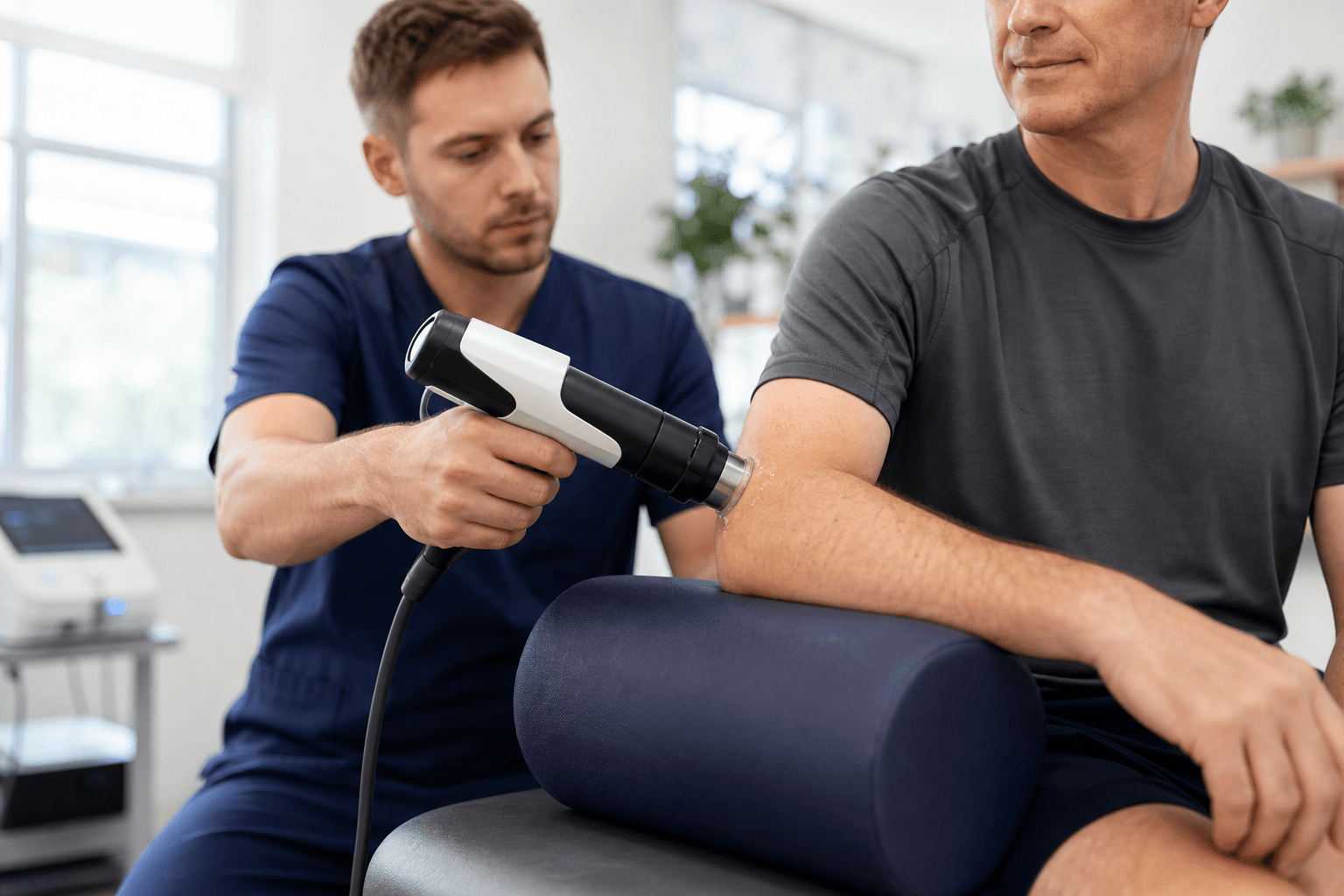
You will be seated or semi-reclined with the elbow supported. The clinician locates the most tender spot and applies coupling gel or a pad. The device applicator is placed on the tendon and pulses are delivered. Typical sensations include buzzing, tapping or brief sharp feelings with each pulse. Practitioners titrate energy and pulse count to your tolerance while aiming to deliver therapeutic energy.
Clinicians use a graded approach: start at a comfortable intensity and increase it within safe limits if tolerated. If the treatment is uncomfortable, the clinician reduces intensity, pauses briefly or uses local pressure to help. This stepwise delivery is described in comparative trials of radial and focused methods (pilot study).
Typical treatment schedules reported in trials
Study protocols vary, so clinicians give individualized schedules rather than one fixed rule. Many trials and clinical programs report three to six sessions spaced one to two weeks apart. Pulse counts and energy settings vary by device and protocol. Your clinician will recommend a plan based on symptom severity, tolerance and early response.
For an overview of trial schedules see: Shock wave therapy for lateral elbow pain.
Aftercare, expected recovery and warning signs to report
After a session, you may notice redness, mild swelling or increased soreness for 24 to 72 hours. Typical advice for the first 48 hours is to avoid heavy lifting or repetitive loading of the affected arm, use paracetamol for discomfort if needed and apply ice for swelling. Your clinician will pair shockwave with a progressive exercise program to load and strengthen the extensor tendons for longer-term recovery.
Contact your clinician immediately if you experience increasing pain that does not settle, growing redness, fever, numbness, new neurological symptoms or signs of infection at the treatment site. If you are on anticoagulants and notice unexpected bruising, seek advice promptly. Trials report mostly mild and transient side effects when patients are screened appropriately (trial review).
How strong is the evidence and what outcomes can you expect
Systematic reviews and meta-analyses show that ESWT often reduces pain and improves function compared with placebo or some alternative interventions, but results are heterogeneous. Differences in energy settings, session counts and outcome measures limit direct comparisons. In practice, many patients experience meaningful improvement, particularly after failed conservative care, but response is not universal and timelines vary.
Key references: the pooled outcome meta-analysis (PubMed) and the broader trial review (PMC review).
Alternatives and how shockwave compares with physiotherapy or injections
Common alternatives are supervised physiotherapy (loading and strengthening), corticosteroid injections, platelet-rich plasma in select settings and noninvasive conservative care. Corticosteroid injections often give short-term relief but may not provide durable improvement, and repeated injections can weaken tendon tissue. Physiotherapy remains foundational and is commonly combined with shockwave for persistent cases. Systematic reviews compare these options without declaring a single best choice; the right approach depends on your history, priorities and clinical findings (systematic review).
What Planet Health Care offers locally and how to book
Planet Health Care is a multidisciplinary clinic inside Sherwood Forest Mall in North London, Ontario. The clinic offers radial shockwave therapy as part of an integrated pathway alongside physiotherapy, chiropractic and registered massage therapy. Practitioners share treatment notes to coordinate a single plan. The clinic provides an assessment-first approach, online booking, same-day appointments when available, direct billing to many extended health insurers and free parking at the mall entrance.
Service details and scheduling: Shockwave therapy at Planet Health Care and Planet Health Care.
Decision checklist and the seven questions to ask your clinician
Use this checklist at your appointment to leave with a clear plan.
- Has my diagnosis been confirmed and have other causes been ruled out?
- Is shockwave recommended for my specific symptoms and prior treatments?
- Which type of shockwave will be used, radial or focused, and why?
- How many sessions are recommended, how often, and what milestones indicate progress?
- What sensations or side effects should I expect during and after treatment?
- Will shockwave be combined with an exercise program or other therapies?
- How is follow-up handled and what is the cancellation or refund policy if I cannot complete the course?
Frequently asked questions
Does shockwave therapy cure tennis elbow and how quickly will I feel better?
Shockwave is not a guaranteed cure, but many patients have meaningful pain reduction and improved function. Some feel improvement within days to weeks, while others need several sessions combined with rehabilitation exercises to notice change. Timelines vary by injury chronicity and individual response (trial review).
How many shockwave sessions will I likely need and how far apart are they?
Protocols vary. Many studies and programs use three to six sessions spaced about one to two weeks apart. Your clinician will tailor number and spacing to your tolerance and response. See trial overviews for typical schedules (trial review).
Is shockwave therapy painful and are there common side effects?
You may feel tapping, buzzing or brief sharp sensations during pulses. Mild local soreness, redness or bruising can occur and usually resolves within a few days. Serious complications are uncommon with proper screening and clinician control. Discuss specific risks during your assessment.
Will my extended health insurance cover shockwave therapy?
Coverage varies by plan and insurer. Planet Health Care offers direct billing to many major extended health insurers. Confirm benefits with your provider or ask clinic reception for help checking coverage.
When is shockwave therapy not recommended for lateral elbow pain?
Shockwave is not recommended in pregnancy, over active infections or malignancy at the site, or when an electronic implant overlaps the treatment field. It is used cautiously with bleeding disorders or anticoagulant therapy. Your clinician will screen for contraindications during assessment.
If you still have questions or want to book an assessment, Planet Health Care can explain the pathway and check your candidacy. Book online or contact the clinic to confirm same-day availability and direct billing options.