
Should You Check Shockwave Therapy for Plantar Fasciitis?
Considering shockwave therapy for plantar fasciitis? Learn what to confirm about diagnosis, goals, rehabilitation, comfort, follow-up, coverage, and care.
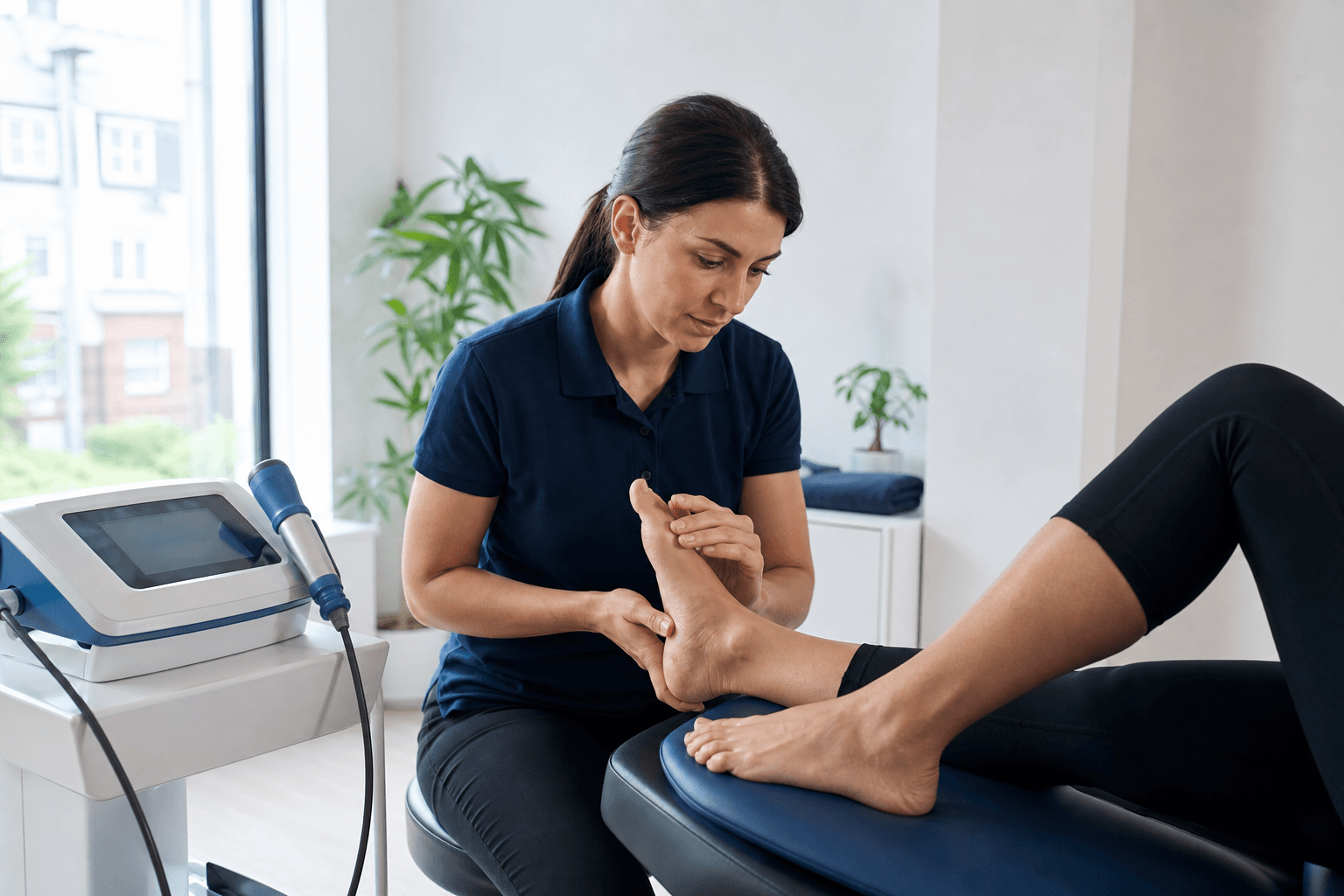
Should You Check Shockwave Therapy for Plantar Fasciitis?
Shockwave therapy may be worth discussing when heel pain persists and plantar fasciitis is being considered. However, treatment should not be selected from a condition label alone. Before booking, confirm what is causing your symptoms, understand what radial shockwave therapy is intended to address, and ask how it fits into a broader rehabilitation plan.
A useful consultation should leave you knowing what was assessed, why shockwave therapy was suggested, what progress will be monitored, and what happens if the plan needs to change. This article provides general educational information, not a personal diagnosis or treatment recommendation. A qualified clinician must assess your individual situation.
Introduction: Start With the Right Question
The first question is not simply, “Where can I book shockwave therapy for plantar fasciitis?” It is, “Has my heel pain been properly assessed, and does shockwave therapy have a clear role in the plan for me?” This distinction helps you avoid choosing a modality before understanding the problem it is supposed to address.
Persistent heel pain can affect walking, standing, exercise, work, sleep, and confidence in movement. Those effects are important to explain, but they do not identify the cause by themselves. A good conversation connects your symptoms and goals with the findings from an individualized assessment.
Planet Health Care provides radial shockwave therapy for plantar fasciitis and offers one-on-one physiotherapy assessments, hands-on rehabilitation, injury recovery, and chronic pain management. That combination matters because shockwave therapy is a treatment option within care, not a promise that one procedure will resolve every cause of heel pain.
1. Confirm That Plantar Fasciitis Is the Problem Being Treated
Heel pain is a symptom, not a complete explanation. Pain under or around the heel can affect walking, standing, exercise, work, and sleep, but those effects do not confirm the cause. If you are searching for plantar fasciitis treatment in London, ask what the clinician found during the assessment.
Share the history behind the pain
Be ready to describe when the pain began, whether it followed a change in activity, how it affects your first steps or longer periods of standing, and what makes it better or worse. Mention previous injuries, surgery, changes in footwear, exercise habits, and care you have already tried.
Also explain whether symptoms vary during the day, limit a particular task, or have changed over time. These details help the provider understand the pattern instead of relying on a short description such as “heel pain.”
You do not need perfect medical language. Explain how the problem behaves and what you need to return to doing. A clear history helps the provider connect the examination to your goals instead of treating a label in isolation.
Ask what the assessment showed
Ask, “What findings support plantar fasciitis in my case?” Also ask whether anything about your symptoms suggests that the plan should change or that additional assessment is needed. You are asking for a plain-language explanation of the reasoning behind the recommendation.
Depending on your situation, the clinician may consider movement, strength, mobility, walking pattern, activity demands, and how symptoms respond to different tasks. The exact assessment should be individualized rather than assumed in advance.
Ask what the provider is trying to learn from each part of the assessment. Understanding the connection between a finding and a recommendation makes it easier to participate in the plan and recognize when it needs to be reconsidered.
Know when to pause
If shockwave therapy is recommended without discussion of your history, examination, or goals, ask how the recommendation was reached. A short appointment does not need to be complicated, but treatment should have a clear connection to an assessed problem.
Pause before committing if you are not sure what is being treated, what the intended benefit is, or how your response will be reviewed. Asking for clarification is a reasonable part of choosing care.
2. Understand What Shockwave Therapy Is Meant to Do
Radial shockwave therapy uses a treatment device to deliver mechanical pressure waves to a targeted area. Planet Health Care offers radial shockwave therapy for plantar fasciitis and tennis elbow. The important decision is whether the provider can explain the treatment’s intended role in your particular plan.
Separate treatment from a guaranteed cure
Shockwave therapy should not be presented as a guaranteed cure for everyone with plantar fasciitis. People differ in symptoms, contributing factors, activity demands, health history, and response to care. The purpose of treatment should be linked to your assessment and goals, not an unconditional promise of pain relief.
Ask whether the aim is to support participation in rehabilitation, address a persistent local problem, or help you work toward a specific activity. The answer should be clear enough for you to decide whether the treatment matches what you want to regain.
You can also ask what the clinician will consider a meaningful response. A useful answer should relate to function, symptoms, or participation rather than relying only on a general statement that the treatment “works.”
Connect treatment to a functional goal
You may want to walk through a workday, return to exercise, stand longer, resume a sport, or manage household responsibilities more comfortably. Tell the clinician what matters to you and ask how progress toward that goal will influence the plan.
A treatment conversation focused only on the painful spot may miss movement, loading, strength, footwear, activity, and confidence. Those factors do not receive the same attention in every case, which is why the plan must follow the assessment.
3. Check Whether the Plan Goes Beyond a Single Treatment
Ask whether the clinic views shockwave therapy as part of rehabilitation or as the entire solution. Planet Health Care describes physiotherapy as including one-on-one assessment, hands-on rehabilitation, injury recovery, post-surgical recovery, and chronic pain management.
Ask what you will do between appointments
Depending on the assessment, your plan may involve exercise, mobility work, gradual activity changes, education, hands-on care, footwear discussion, or review of whether orthotic assessment is relevant. You may not need every option. The provider should explain which elements apply to you and why.
- What will I do between appointments?
- Which activities should I continue, modify, or temporarily avoid?
- Will you assess strength, mobility, walking, or loading factors?
- Would footwear or orthotic review be relevant?
- How can the plan fit my work, sport, or family responsibilities?
Between-appointment guidance should be practical. Ask how often to perform an activity, what response is expected, and what change would mean you should contact the clinic. If instructions are unclear, request an example connected to your normal day.
Do not assume more treatment is better
A multidisciplinary clinic may offer physiotherapy, chiropractic care, registered massage therapy, acupuncture, custom orthotics, and other services in one location. That does not mean you need several services. Ask how each recommendation supports your goals and how practitioners will keep the plan consistent.
Coordinated care should reduce confusion, not create a longer list of appointments without a clear purpose. If more than one service is suggested, ask which goal each service addresses and how the providers will share relevant information.
4. Ask How Progress Will Be Evaluated
Promises about a specific number of appointments, a fixed recovery timeline, or guaranteed improvement should not replace an individualized discussion. Your response must be evaluated as care progresses.
Define improvement
Ask what will be tracked. Measures may include your ability to walk, stand, exercise, work, or complete a particular task. You might also track activity tolerance, symptom behaviour, movement quality, or confidence using the foot. The most useful measures depend on your goals.
Write down activities that currently cause difficulty, such as walking across campus, standing during a shift, or completing a workout. Specific examples give you and the clinician something practical to revisit.
It is also useful to distinguish a short-term change in symptoms from a broader improvement in function. Ask how both will be considered, especially if your pain varies from day to day.
Ask when the plan will be reviewed
Ask when progress will be reviewed and what would prompt a change. If progress is limited, the answer should not be to continue indefinitely without reconsidering the assessment and plan. Also ask whom to contact if symptoms change between visits.
A review does not necessarily mean treatment has failed. It may mean the clinician needs to revisit the working explanation, adjust the rehabilitation approach, or discuss another option. The important point is that the plan should remain responsive to your progress.
5. Discuss Sensations, Comfort, and Communication
People often want to know what shockwave therapy will feel like. The clinician who assesses you can provide the most relevant explanation. Sensations can vary according to the person, treatment area, and plan, so another patient’s pain rating should not be treated as a prediction.
Ask what will happen, where treatment will be applied, how the appointment will be paced, and how to communicate if the experience is uncomfortable. You should feel able to ask questions and speak up during treatment.
Before treatment, tell the provider about relevant health information, current treatments, previous procedures, and anything that could affect care. Do not assume an online service description means treatment is automatically suitable for you. Medical suitability requires qualified clinical review.
Ask what instructions apply after an appointment and how the clinic wants you to respond if symptoms change. Clear communication helps you make informed decisions without treating general online information as personal medical advice.
6. Check Whether the Clinic Fits Your Practical Needs
Consider whether the clinic assesses before treating, explains findings in plain language, connects care to your goals, and provides a clear way to review progress. These checks are useful for shockwave therapy, physiotherapy, or other rehabilitation services.
Check access
Ask how to book an initial assessment and what information to bring. Planet Health Care offers online booking and same-day appointments when available, but availability should be confirmed rather than assumed.
The clinic is located at Unit 15 in Sherwood Forest Mall in North London, Ontario, with free mall parking. This may be convenient if walking from a distant parking area is difficult.
For students and staff near the Western University area, and for residents of Sherwood Forest, Masonville, Hyde Park, Whitehills, Oakridge, and Fox Hollow, location and appointment availability may be practical factors in maintaining a rehabilitation plan.
Ask precise insurance questions
Planet Health Care offers direct billing to many major extended health insurers. This does not mean every insurer, plan, appointment, or shockwave service is automatically covered. Check your plan and ask whether direct billing applies to the service you are considering.
Clarify whether you must pay a portion directly, whether your insurer requires a referral, and whether assessment, treatment, orthotics, or other products have separate costs. Request an explanation of any amount that remains your responsibility before beginning care.
Considering Shockwave Therapy in London, Ontario?
Planet Health Care offers radial shockwave therapy for plantar fasciitis at Unit 15 in Sherwood Forest Mall in North London. The clinic also provides physiotherapy assessments and rehabilitation, allowing you to discuss shockwave therapy alongside a broader plan.
The clinic serves North London and areas including Sherwood Forest, Masonville, Hyde Park, Whitehills, Oakridge, Fox Hollow, and the Western University area. Online booking, free mall parking, direct billing to many major insurers, and same-day appointments when available may make care easier to arrange.
When contacting the clinic, explain that you are seeking assessment for persistent heel pain and want to discuss whether radial shockwave therapy may fit your rehabilitation plan. Ask which appointment is appropriate, whether the service is available for your situation, and what insurance information the clinic needs.
Questions to Bring to a Shockwave Consultation
Choose the questions that address your main uncertainty and write down the answers. You do not need to ask every question, but bringing a short list can help you compare the recommendation with your goals and practical needs.
Diagnosis
- What did you find during the assessment?
- Why do you think plantar fasciitis contributes to my pain?
- Are other factors affecting my symptoms or walking?
Treatment purpose
- What role would radial shockwave therapy have?
- What functional goal are we working toward?
- What would make you adjust the recommendation?
Rehabilitation
- What should I do between appointments?
- Will exercise, mobility, activity, footwear, or orthotics be relevant?
- How will the plan fit my daily responsibilities?
Follow-up and coverage
- What sensations might I notice?
- When will progress be reviewed?
- What alternatives could be considered?
- Does my plan cover the service, and can claims be submitted directly?
Frequently asked questions
Does everyone with plantar fasciitis need shockwave therapy?
No. Suitability depends on your history, assessment findings, goals, previous care, and clinical reasoning. Shockwave therapy may be one option, but you should not assume it is necessary without individual assessment.
Should I have an assessment before booking?
Assessment connects the treatment to your symptoms, movement, activity demands, and goals. Ask the clinic which appointment type is appropriate when booking. Planet Health Care offers physiotherapy assessment and radial shockwave therapy.
Can shockwave replace physiotherapy exercises?
You should not assume that it can. Whether exercise, mobility work, activity guidance, footwear discussion, or another rehabilitation strategy is relevant depends on your assessment. Ask how shockwave fits into the full plan.
How can I ask about treatment in London, Ontario?
Describe how long you have had heel pain, what activities are difficult, and what care you have tried. Ask about an assessment-first appointment, radial shockwave therapy, follow-up, direct billing, and availability.
Conclusion: Make Assessment the First Check
Shockwave therapy for plantar fasciitis may be reasonable to discuss, but the decision should begin with assessment. Confirm what contributes to your heel pain, ask what radial shockwave therapy is intended to do, and connect the recommendation to a functional goal.
Then check the rest of the plan: rehabilitation, comfort, progress measures, follow-up, alternatives, and coverage. Choose a provider willing to assess first and explain the reasoning clearly. A careful decision does not require rejecting shockwave therapy. It requires understanding why it has been suggested and how your response will guide the next step.
If you are in London, Ontario, contact Planet Health Care or book an assessment to discuss persistent heel pain and whether radial shockwave therapy and physiotherapy may fit your needs, subject to clinical suitability and availability.