
Return-to-Play Rehabilitation: A Practical Guide to Returning to Sport Safely
Learn how return-to-play rehabilitation progresses from assessment to competition, with safety checks, concussion guidance, and London clinic questions.
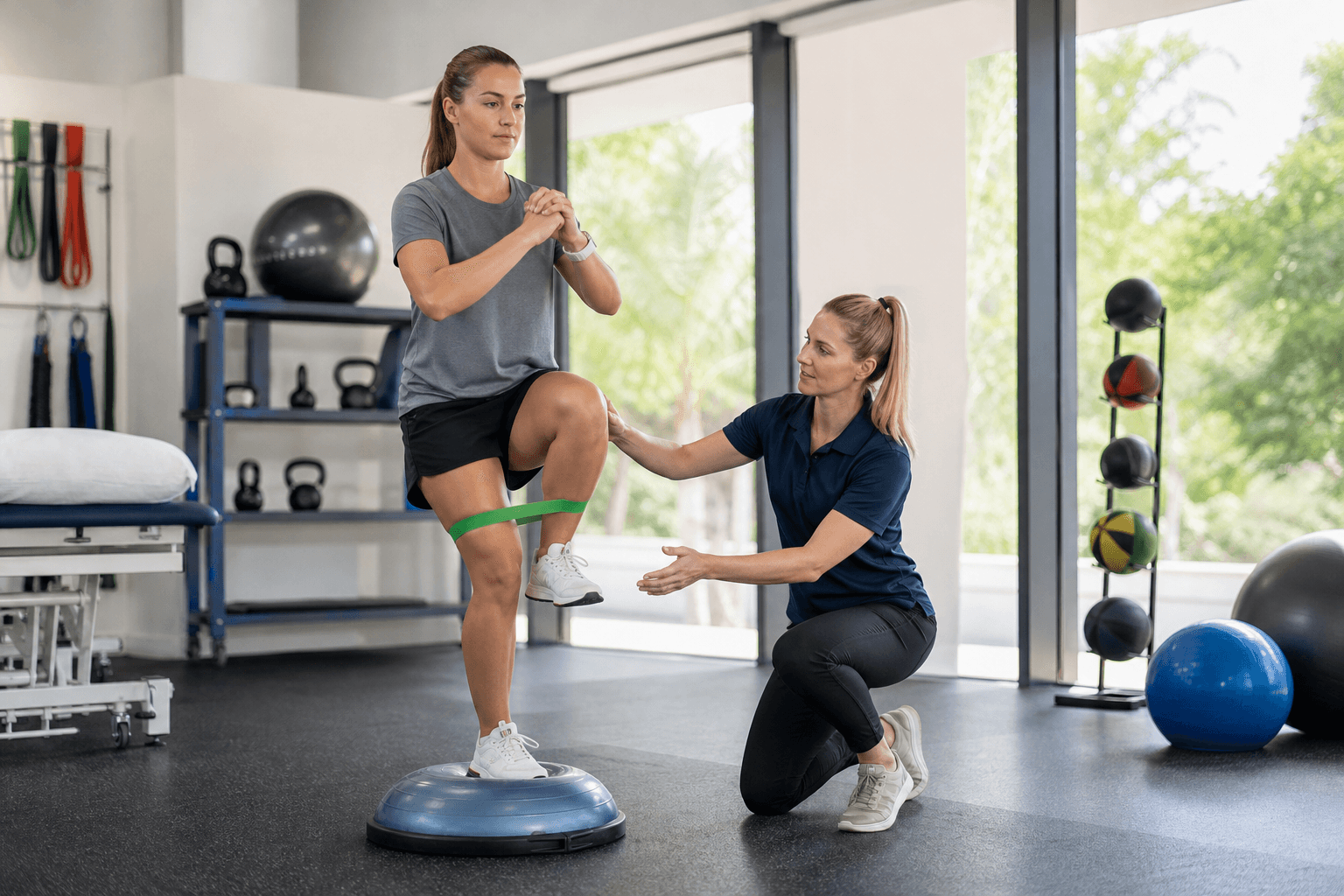
Return-to-play rehabilitation is usually a progression, not a date chosen because your pain has improved. A safe plan gradually tests daily movement, mobility, strength, control, sport-specific demands, training and competition while monitoring how your body responds.
This guide explains the main stages, signs that may support progression, and warning signs that call for a pause or reassessment. It is general education, not individual medical clearance. A qualified healthcare professional should help determine when you are ready for your specific sport, injury and level of competition.
Quick summary
- Begin with an assessment of your injury, movement, strength, function and sport demands rather than relying on pain alone.
- Progress from basic daily movement to sport-specific drills, practice and competition in manageable steps.
- Track symptoms during activity and later that day or the next day. Worsening pain, swelling, instability or altered movement may mean you progressed too quickly.
- Concussion recovery follows a separate graduated return-to-sport process and may involve formal requirements under Ontario’s Rowan’s Law.
- Ask a clinic how it will assess you, build your plan, monitor progression and coordinate any required support equipment or referrals.
What return-to-play rehabilitation actually involves
Return-to-play rehabilitation rebuilds the capacity needed for your sport after an injury, surgery or period of reduced activity. It is more than reducing pain or completing a few comfortable exercises. Your plan may need to address range of motion, strength, balance, coordination, landing or cutting mechanics, confidence and the repeated loads your sport places on the injured area.
A useful first step is a one-on-one physiotherapy assessment that considers your history, movement testing and functional goals. Planet Health Care describes a written plan, plain-language explanation, hands-on treatment and individualized home exercises as part of its physiotherapy process.
The right progression depends on the injury and the athlete. A recreational runner returning after a calf strain will not follow the same process as a soccer player recovering from knee surgery or a student athlete managing a shoulder injury. A calendar can provide context, but it cannot demonstrate readiness for the next demand.
The main stages of a gradual return to sport
The stages below are a framework for discussion with a clinician, not a self-clearance protocol. You may move between stages more than once, and some injuries require additional medical or surgical guidance.
| Stage | Goal | What may be introduced | Pause or reassess if |
|---|---|---|---|
| Assessment and symptom control | Understand the injury and establish safe starting points | History, movement testing, gentle activities and an initial home plan | Symptoms are severe, unexplained, worsening or associated with major loss of function |
| Daily movement and mobility | Restore comfortable basic movement | Walking, everyday tasks, mobility work and low-demand exercises | Pain, swelling or stiffness increases during or after ordinary activity |
| Strength and movement control | Build capacity and improve control | Progressive strengthening, balance, coordination and technique work | You compensate, lose control, experience giving way or cannot tolerate the load |
| Sport-specific loading | Prepare for sport demands | Running, changing direction, jumping, throwing, lifting or graded drills | Symptoms return with speed, impact, rotation or repeated effort |
| Practice or training | Test skills and workload in a controlled setting | Partial practice, modified drills, planned rest and gradual volume increases | Symptoms persist into the next day or performance changes because of the injury |
| Competition or full participation | Return to normal demands with prevention planning | Full participation when clinical and sport requirements are met | You rely on medication to push through, protect the area or lose control |
How to judge progress between stages
Progress is based on more than whether you feel comfortable at one moment. Discuss how symptoms behave during activity, immediately afterward and later that day or the next day. A gradual increase in demand should not create a pattern of worsening pain, swelling, stiffness or reduced function.
Movement quality is also important. Can you perform the required task without obvious compensation, loss of balance or reduced control? Depending on the injury, a clinician may compare strength, mobility or functional performance between sides. The relevant standard varies by sport and injury.
Confidence matters, but confidence alone is not proof of readiness. The key question is whether your body can tolerate the next level of load while maintaining appropriate movement and recovering between sessions.
How physiotherapy can support a return-to-play plan
Physiotherapy may help identify why movement remains limited, build a staged exercise plan and adjust workload as capacity changes. Treatment can include education, hands-on care, progressive strengthening, movement retraining and selected modalities when clinically appropriate.
A home exercise program helps you continue building capacity between appointments. Exercises should match your assessment and current stage rather than coming from a generic online protocol. Follow-up appointments can help determine whether to progress, hold steady or modify the plan.
For parents supporting a young athlete, the goal is not simply to reach the next game. A useful overview of what parents should know before booking pediatric physiotherapy can help frame questions about assessment and support, although the treating clinician should guide the individual plan.
When support equipment may be part of rehabilitation
A brace is not necessary for every athlete and does not replace strength, movement retraining or medical guidance. It may be considered when stability, alignment, pain management, post-surgical recovery or confidence is part of the rehabilitation discussion.
Fit matters. Depending on the injury, custom orthopedic bracing may be assessed and fitted for areas such as the knee, ankle, wrist, shoulder or spine. A clinician or qualified fitter can discuss whether a brace is appropriate and how it should be used.
Concussion recovery requires a separate return-to-sport process
Concussion recovery should not be treated like an ordinary muscle, tendon or joint injury. Ontario sport organizations must maintain return-to-sport protocols when an athlete has, or is suspected of having, a concussion under Rowan’s Law.
Ontario guidance describes a graduated process that begins with daily activities and relative rest, followed by light and moderate aerobic exercise before more demanding sport activity. The exact steps depend on symptoms and medical guidance, so an athlete should not use a general online checklist as personal clearance. The provincial concussion awareness resource explains the broader framework.
If concussion symptoms are present, follow the instructions of the healthcare professional managing the injury. Physiotherapists may support recovery, but the appropriate professional must determine assessment, restrictions and readiness for each stage.
Return-to-play safety checklist
Slow down, stop the progression or seek reassessment if you notice:
- Worsening or persistent pain.
- Increasing swelling, stiffness or loss of range of motion.
- Instability, giving way or catching.
- Altered movement, limping or worsening technique with fatigue.
- Reduced strength, balance, coordination or function.
- Symptoms that return after training or worsen the next morning.
- New neurological or concussion-related symptoms, including worsening headache, dizziness, confusion or concentration problems.
Seek urgent medical care for severe or rapidly worsening symptoms, a serious new injury, major loss of function or other concerning symptoms. Do not train through suspected concussion or use medication to conceal symptoms while testing readiness.
Questions to ask when booking rehabilitation in London
- Who will perform the initial assessment, and will it include movement and functional testing?
- How will the plan reflect the demands of my sport?
- What home exercises are included, and how will the program progress?
- How will we decide whether to advance, hold or reduce activity?
- Could bracing or another service be relevant?
- How does the clinic handle suspected concussions and referrals?
- Is direct billing available, and are same-day appointments available?
Be ready to explain when the injury happened, what makes it worse, what you have tried, whether surgery was involved and what you want to return to.
Practical considerations for choosing a London clinic
Convenience can affect whether you attend consistently and follow through with rehabilitation. Coordinated disciplines may be useful when recovery involves more than one type of care, although you should understand who is responsible for each part of your plan.
Planet Health Care is a multidisciplinary rehabilitation clinic at Sherwood Forest Mall in North London, offering physiotherapy, chiropractic care, registered massage therapy, psychology, shockwave therapy, acupuncture and pelvic floor physiotherapy. The clinic also states that it offers online booking, same-day appointments when available, direct billing to many major extended health insurers and free parking at the mall.
Frequently asked questions
How long does return-to-play rehabilitation take?
There is no single timeline. Recovery depends on the injury, surgery, baseline capacity, sport demands and response to loading. A clinician can set milestones without promising a fixed return date.
Can I return to sport if I still have some pain?
Some injuries may involve manageable symptoms during rehabilitation, but pain alone cannot establish safety. Discuss the intensity, pattern and timing of symptoms with a qualified clinician.
Do I need a brace to return to sport?
Not necessarily. A brace may be considered for stability, alignment, recovery, pain management or confidence, but it should be appropriately selected and fitted. It does not replace rehabilitation.
Do I need a doctor’s referral for physiotherapy?
Requirements can depend on the service, insurer and circumstances. Ask the clinic when booking and check your extended health plan if you want direct billing.
Conclusion: treat return to sport as a progression
Effective return-to-play rehabilitation moves from basic function toward the specific speed, strength, control and repeated demands of your sport. Use symptoms, movement quality and recovery between sessions as information to discuss with a clinician, not as permission to rush.
For an assessment-first rehabilitation plan in North London, Planet Health Care can discuss your injury, activity goals, available physiotherapy support and the next practical step.