
Plantar fasciitis shockwave vs other treatments: how to choose
Compare shockwave therapy for plantar fasciitis with injections, PRP, physio, orthotics and ultrasound. Who benefits, risks, and how to book in London, ON.
Plantar fasciitis shockwave vs other treatments: how to choose
If chronic heel pain has not improved with stretching, footwear changes and a supervised physiotherapy program, extracorporeal or radial shockwave therapy is one nonoperative option to consider. This article compares plantar fasciitis shockwave with common nonoperative alternatives, summarizes the best available evidence, explains who is usually a candidate, describes what to expect during a course of treatment, and gives practical steps for choosing a local clinic in North London, Ontario.
Short take: what the evidence says about shockwave for plantar fasciitis
Meta-analyses and clinical reviews
High-level reviews find that shockwave therapy can be an effective nonsurgical treatment for recalcitrant plantar fasciitis. A meta-analysis concluded that focused application of shockwaves to the plantar fascia insertion is a safe and effective nonsurgical method for chronic cases that have not responded to other therapies (meta-analysis). A broader clinical review likewise reported that, in available trials, shockwave therapy shows benefit compared with placebo and may have outcomes comparable with platelet-rich plasma, corticosteroid injection or surgery in limited evidence sets (clinical review).
Randomized trials and mixed results
Not every randomized, placebo-controlled trial shows a clear benefit. Some well conducted trials report equivocal or mixed results, which suggests that patient selection, device type, energy dose and treatment protocol all influence outcomes (randomized trial). A recent systematic review and meta-analysis comparing extracorporeal shockwave therapy with ultrasound and other modalities concluded that shockwave is a reasonable option for chronic plantar fasciitis while noting variability across studies (systematic review).
Bottom line for patients
Shockwave therapy is an evidence-based option for many people with chronic plantar fasciitis after conservative care has failed. The evidence supports cautious optimism: several studies report benefit, but individual responses vary. A clear diagnosis and an assessment-first approach help decide whether shockwave should be used alone or as part of a broader rehab plan.
How shockwave compares with other nonoperative options
Below is a practical comparison of shockwave therapy against common alternatives. For each option I summarize the evidence strength, practical advantages, trade-offs, and where shockwave tends to differ.
Corticosteroid injections
- Evidence and effect: Steroid injections commonly provide short-term pain relief, but benefits can wane and rare harms such as plantar fascia rupture have been reported.
- Trade-offs: Faster symptom control for some patients, but not always durable. Useful when rapid relief is needed.
- How shockwave differs: Shockwave aims to stimulate tissue healing rather than suppress inflammation. Clinical reviews suggest shockwave may offer longer-lasting improvement than a single steroid injection for some chronic cases (clinical review).
Platelet-rich plasma (PRP)
- Evidence and effect: Limited trials compare PRP with other treatments. Some studies report similar outcomes to shockwave or surgery, but methods and sample sizes vary.
- Trade-offs: PRP is an injectable biologic that can be costly and protocol standards are evolving.
- How shockwave differs: Shockwave is noninvasive and requires no blood processing. Some reviews report comparable effectiveness in limited studies, but the evidence base is not conclusive (clinical review).
Physiotherapy and exercise programs
- Evidence and effect: Targeted loading programs, plantar fascia stretching and calf strengthening are first-line treatments with strong support for initial care.
- Trade-offs: Physiotherapy is low risk and builds function, but some chronic cases do not fully respond to exercise alone.
- How shockwave differs: Shockwave is typically considered after an adequate, well-delivered physiotherapy course. Best practice is to integrate shockwave within a broader rehabilitation plan rather than use it as a standalone shortcut (systematic review).
Custom orthotics and night splints
- Evidence and effect: Orthotics and night splints reduce strain on the plantar fascia and help many patients, especially where foot mechanics or footwear are contributors.
- Trade-offs: Conservative and low risk; may not resolve pain in recalcitrant cases alone.
- How shockwave differs: Shockwave targets tissue pathology. Combining orthotics and shockwave is a common strategy when mechanics and tissue changes both matter.
Ultrasound and low-level laser therapy
- Evidence and effect: Trials show mixed benefits. Some reviews find that shockwave produces more consistent results than ultrasound, but high-quality head-to-head comparisons remain limited (systematic review).
- Trade-offs: Ultrasound is noninvasive and inexpensive per session, but may require many treatments and show smaller effects in chronic cases.
Surgery
- Evidence and effect: Surgical plantar fasciotomy is a last-resort option for truly refractory cases. It can provide relief but carries operative risks and recovery time.
- Trade-offs: Invasive and appropriate only after exhausting reasonable nonoperative care. Some reviews suggest shockwave outcomes may approach surgical results for selected patients, but evidence is context dependent (clinical review).
Who is a suitable candidate and who should avoid shockwave
Typical candidate profile
Shockwave is most often offered to people with chronic plantar fasciitis who have tried conservative measures such as a supervised physiotherapy program, orthotics, stretching and activity modification without adequate improvement. That profile aligns with the patient groups studied in many trials and meta-analyses (meta-analysis).
Common contraindications and precautions
- Pregnancy and active infection at the treatment site
- Bleeding disorders or anticoagulant use without medical clearance
- Malignancy in the treatment area
- Certain implanted electronic devices near the treatment site
An assessment by a qualified clinician is essential to confirm the diagnosis and identify red flags that require imaging or specialist referral before considering shockwave.
What to expect during a shockwave course and early recovery
Session experience and sensations
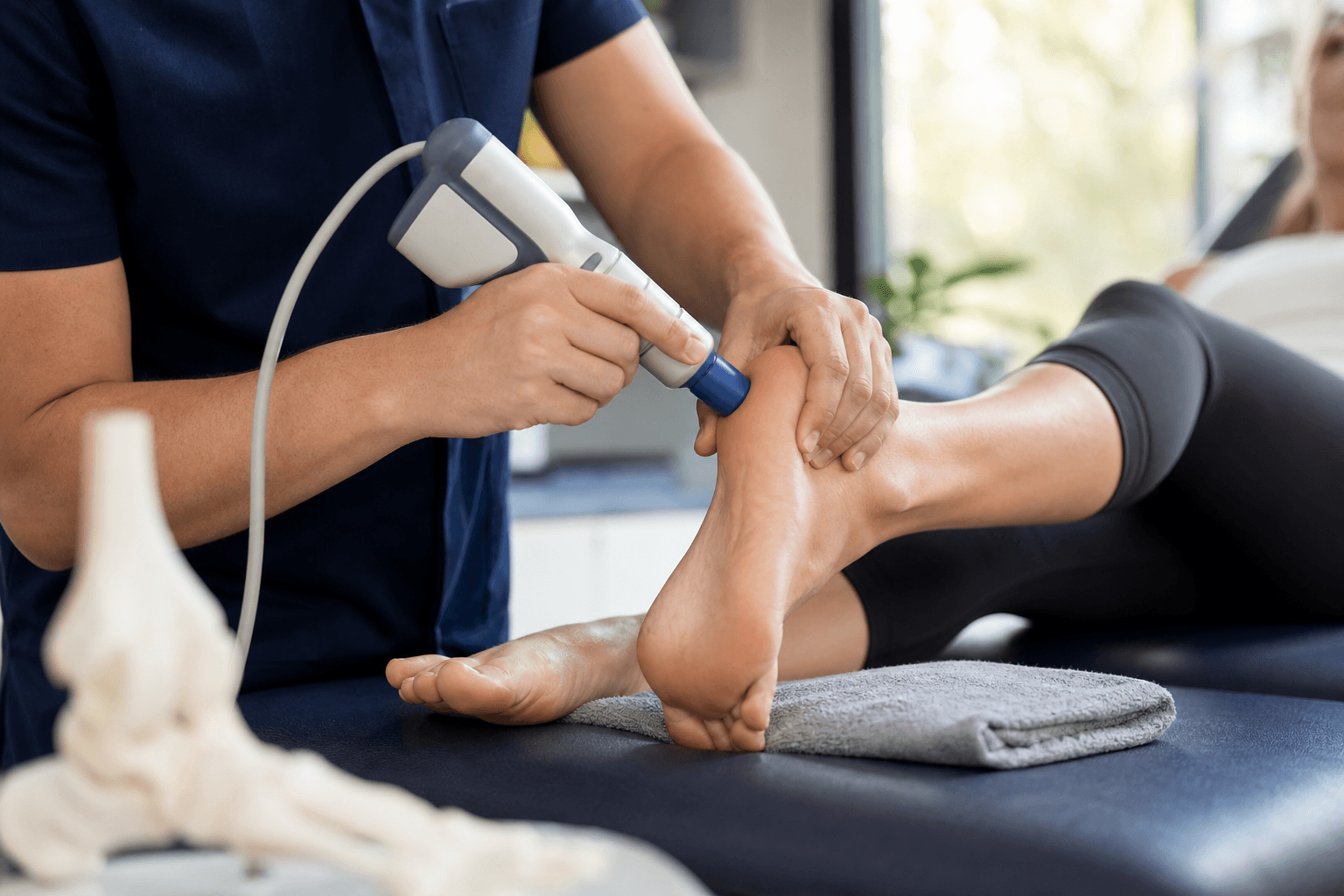
Treatment is delivered in an outpatient clinic with a handheld device that transmits acoustic pulses into the tissue. Many patients feel brief discomfort or a tapping sensation during the session. Practitioners usually adjust intensity to a tolerable level and pair therapy with loading exercises and home care. Protocols vary by device and clinic, which helps explain some variability in trial results (trial).
Side effects and aftercare
Common side effects are transient pain at the treatment site, local swelling, bruising and numbness that usually resolve within days to weeks. Serious complications are uncommon. Combining shockwave with physiotherapy, footwear adjustments and orthotic assessment improves the chance that any gains translate into lasting function (systematic review).
Timeline for assessing benefit
Some patients notice improvement within a few weeks of a treatment course, while others need longer to show meaningful change. Because responses vary, clinicians should set an evaluation point and discuss whether to continue, repeat or combine treatments based on documented progress.
Real objections patients raise and balanced answers
- Does it hurt? Expect brief discomfort during treatment. Clinicians adjust intensity and many patients tolerate sessions well.
- Why do trial results conflict? Differences in device type, energy dose, session number and patient selection cause variability across trials (trial).
- Is it worth the cost? If prior conservative care has failed, shockwave may be a reasonable noninvasive alternative to injections or surgery. Ask your insurer and clinic about likely costs and direct-billing options.
- Will insurance cover it? Coverage varies by plan. Ask your insurer and confirm whether the clinic can direct bill. Planet Health Care advertises direct billing to many extended health insurers and online booking to simplify scheduling.
How to choose a local clinic in London, Ontario
Use this decision checklist when comparing providers.
- Assessment-first care, with a one-on-one assessment that confirms plantar fasciitis and rules out other causes. An assessment-first approach ensures treatment matches the diagnosis.
- Multidisciplinary coordination, where physiotherapy, orthotics fitting and shockwave are available under one roof so care is aligned.
- Device type and clinician training, ask which shockwave device is used and about the clinician’s experience delivering it.
- Outcome tracking and follow-up, request how progress will be measured and when benefits will be reviewed.
- Logistics, confirm direct-billing, booking ease, accessibility and parking. These practical items often determine whether you complete the recommended course.
Planet Health Care offers radial shockwave therapy alongside physiotherapy, orthotic fitting and other rehabilitative services, so patients in North London can receive an integrated plan in a single location. The clinic advertises same-day appointments when available, online booking and direct billing to many extended health insurers.
Practical next steps for London, ON patients
- Gather prior notes, imaging or details of previous treatments to bring to your assessment.
- Book a one-on-one assessment that specifies whether shockwave is appropriate for your case.
- Ask the clinic about device type, expected treatment course, likely costs and whether they can direct bill your insurer.
- Plan to combine shockwave with a tailored physiotherapy program or orthotic assessment if recommended.
Frequently asked questions
Is shockwave therapy effective for plantar fasciitis compared with other nonoperative treatments?
Evidence supports shockwave as an effective option for many patients with chronic plantar fasciitis after conservative care has failed. Meta-analyses and clinical reviews report benefit over placebo in several studies and suggest comparable outcomes to some injections or surgery in limited trials, though results vary by device and protocol (meta-analysis), (clinical review).
How many shockwave sessions will I likely need and how long before I notice improvement?
Protocols vary and there is no universal session count. Some clinicians deliver a small number of higher-energy sessions, others use multiple lower-energy sessions. Some patients report improvement within weeks of a course, while others need longer. Your clinician should outline a protocol and a scheduled reassessment.
Does shockwave therapy hurt and what are the common side effects?
Treatment can cause brief discomfort during the session. Common side effects include local pain, bruising and transient numbness or swelling. Serious complications are uncommon; practitioners adjust intensity to patient tolerance and provide aftercare guidance (trial).
Will my extended health insurance cover shockwave therapy and does Planet Health Care direct bill?
Coverage depends on your insurer and plan. Ask your insurer and the clinic before booking. Planet Health Care advertises direct billing to many extended health insurers and offers online booking to simplify scheduling (clinic) and (book online).
When should I choose injections, PRP, or surgery instead of shockwave?
Injections may be chosen for rapid short-term relief. PRP is an alternative biologic approach with evolving evidence. Surgery is reserved for truly refractory cases after exhausting reasonable nonoperative care. Decisions should follow a careful assessment, discussion of risks and benefits, and consideration of how well you responded to prior conservative measures (clinical review).
If you are ready to explore whether plantar fasciitis shockwave is appropriate for your heel pain, book a one-on-one assessment and discuss an integrated plan that may include physiotherapy, orthotics and on-site shockwave at Planet Health Care. Bring previous treatment notes or imaging and ask about direct billing and expected follow-up so you can make an informed decision.