
Is shockwave therapy in London, Ontario right for my tendon pain?
Step-by-step checklist to decide if shockwave therapy in London, Ontario suits persistent tendon pain, with safety stop points, booking tips, and prep.
Is shockwave therapy in London, Ontario right for my tendon pain?
If you live in North London and are researching shockwave therapy in London, Ontario as an option for persistent tendon pain, this article gives a clear, step-by-step checklist to decide, prepare, and compare clinics. The process below shows when clinicians commonly consider shockwave, how to gather the right information before you book, what happens at your first assessment and treatment, safety stop points, and the local logistics you should confirm so your visit is efficient.
Decide whether shockwave therapy is commonly considered for your problem
Shockwave therapy is a modality clinicians often use for chronic tendon problems that have not improved with initial conservative care. Common conditions where providers discuss shockwave include plantar fasciitis, lateral elbow tendinopathy (tennis elbow), and stubborn tendon pain that remains after exercise modification, targeted physiotherapy, or orthotics. Planet Health Care lists radial shockwave therapy among its services and highlights tendon problems such as plantar fasciitis and tennis elbow as typical sub-offerings, which is a useful local starting point when you are weighing options.
Use this quick checklist to decide whether it is worth discussing shockwave with a clinician:
- Your pain or function has not meaningfully improved after 6 to 12 weeks of conservative care such as guided physiotherapy, home exercise, load modification, or shoe changes.
- Your symptoms are primarily related to a tendon or enthesis (where tendon meets bone) rather than diffuse joint arthritis or a nerve problem.
- You have had an assessment that included hands-on evaluation and a clear working diagnosis; the provider has proposed targeted options beyond passive care.
- You can attend multiple sessions and commit to the complementary exercises or loading program your clinician prescribes.
If these items describe you, a focused conversation about shockwave can be the next step. For a summary of shockwave services near London, see a nearby practice example for comparison at shockwave therapy cambridge.
Step 1: Gather information before you book
Before you call or book online, collect the essentials so your first assessment is efficient and clinically useful. Planet Health Care accepts online booking and offers same-day appointments when available, so having this material ready helps the clinic assess urgency and fit for shockwave therapy during your initial visit.
What to record and bring
- Symptom diary: Note when pain started, what makes it better or worse, and how symptoms affect daily tasks. Record activity or recent changes that preceded the pain.
- Previous treatments: List physiotherapy, injections, orthotics, medications, or devices you tried and how long you tried them.
- Imaging and reports: Bring any recent ultrasound, X-ray, or MRI reports and the images if available. If you do not have imaging, the clinician will decide whether it is needed.
- Medication and medical history: Bring a current medication list and note conditions such as bleeding disorders, pacemakers, or pregnancy that clinicians routinely ask about.
- Insurance information: If you plan to use extended health benefits, have your insurer details or card ready; Planet Health Care provides direct billing to many major extended health insurers for eligible services, which can simplify payment for eligible visits.
- Comfortable clothing: Wear loose clothes that allow access to the treated area.
Step 2: What to expect at the first assessment and during treatment
Planet Health Care follows an assessment-first approach, meaning your clinician will perform a one-on-one evaluation before recommending shockwave. Expect a focused history and physical exam, discussion of your prior care, and a shared plan that may include shockwave as a single component among physiotherapy, orthotics, or manual therapy.
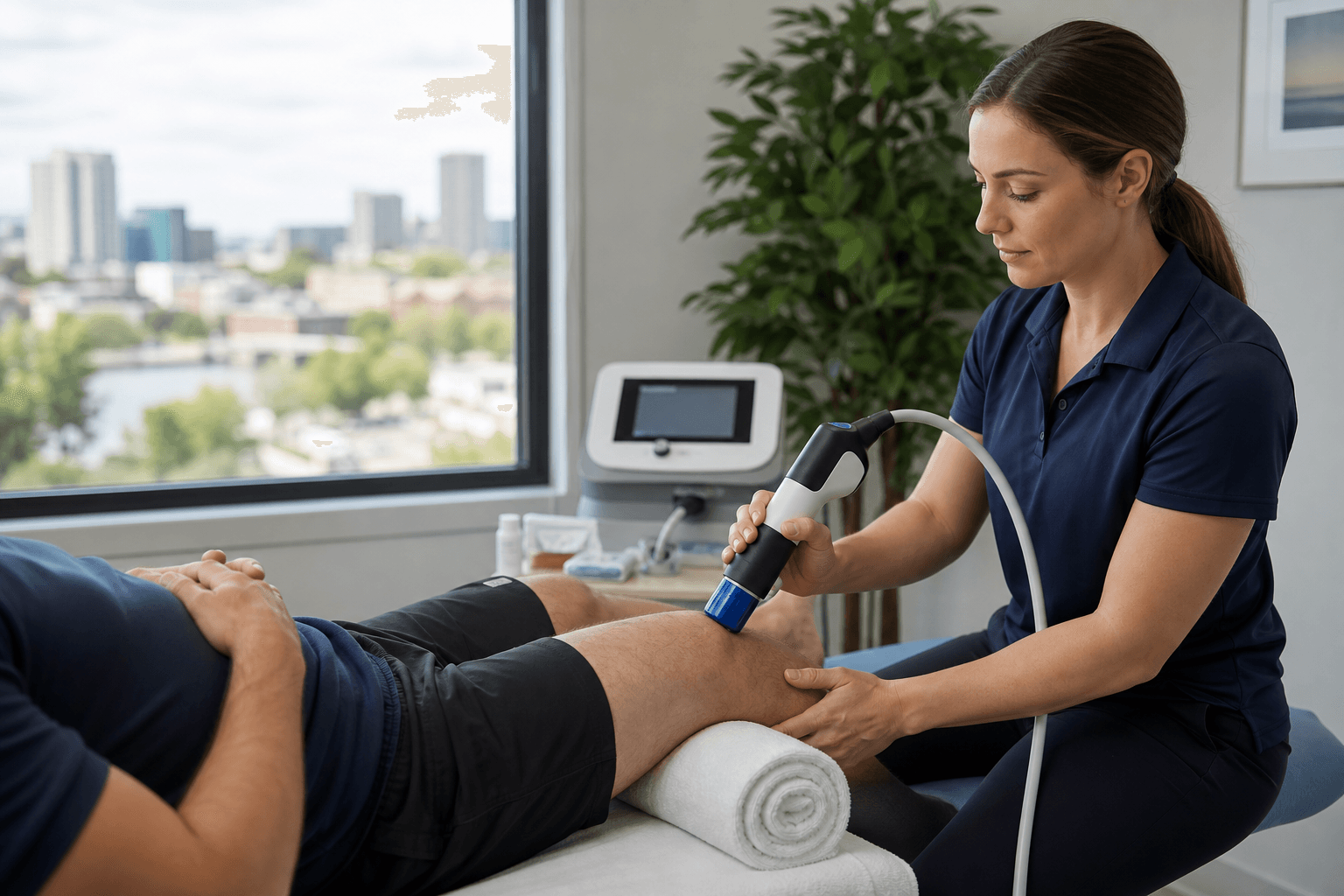
If shockwave is recommended, a typical course involves multiple sessions scheduled over several weeks. During a session the clinician locates the painful area, may use therapeutic gel, and applies radial shockwave pulses with a handheld applicator. Clinicians tailor the number of pulses and energy to your tolerance and the treatment goals. You should receive clear instructions about post-treatment activity, exercises, and signs to watch for between sessions.
Planet Health Care emphasizes coordinated care across disciplines, so your shockwave sessions may be integrated with physiotherapy, massage therapy, or orthotics fitting if those services are appropriate for your case. If you want to confirm coordinated planning before booking, mention that shared-note care is important to you when you call the clinic.
Step 3: Safety limits, common contraindications, and stop points
Clinicians set safety limits and commonly screen for conditions that change treatment decisions. Before any shockwave session, tell your provider about pregnancy, active infection near the treatment site, recent steroid injections in the same area, bleeding disorders, or use of anticoagulant medications, since these factors affect clinical choice. Your practitioner will determine suitability based on an individual assessment.
Know these clear stop points and actions to take:
- New or rapidly worsening neurological symptoms, such as increasing numbness, tingling, or progressive weakness in the limb, require immediate clinician review and often urgent medical assessment.
- Marked swelling, redness, warmth, or fever after treatment may indicate infection; stop treatment and contact your provider or seek emergency care.
- Severe, unusual pain not relieved by prescribed measures after or during a session should prompt you to pause further sessions until a clinician re-evaluates the area.
- Any new chest pain, fainting, or symptoms outside the treated area require emergency services.
If any of these occur, stop treatment and get timely medical advice. Your clinician will explain whether modifications, imaging, specialist referral, or delay of further shockwave sessions are needed.
Step 4: Questions to ask a clinic before you commit
Use this compact checklist to compare clinics in London, Ontario. Asking these items helps you evaluate clinical skill, how outcomes are measured, and local logistics like booking and billing.
- Who will perform my assessment and the shockwave sessions? Ask for the clinician’s profession and training in shockwave techniques.
- What device do you use: radial or focused shockwave? Ask how the clinic decides between device types for my condition.
- How do you measure progress? Ask about clinical milestones, functional tests, or repeated pain scales used to judge response.
- How many sessions do you typically recommend and at what interval? Ask what triggers a change in plan if I do not improve.
- Can shockwave be combined with physiotherapy, orthotics, or massage here? Confirm coordinated care options and note whether practitioners share treatment notes.
- Do you offer direct billing to my insurer and can you estimate coverage? Confirm whether the clinic can bill your plan directly for eligible services.
- What is your cancellation or same-day appointment policy? Ask about availability in case you need quick access.
Comparing answers from two or three local clinics helps you choose a practice that fits your expectations. For perspective on how providers describe device choice and protocols, you can review other nearby practice pages such as shockwave therapy cambridge when weighing options.
Step 5: Alternatives and complementary treatments to consider
Shockwave is one option among several evidence-informed strategies for tendon pain. Planet Health Care lists complementary services patients commonly combine with shockwave, including physiotherapy, chiropractic, registered massage therapy, acupuncture, and custom orthotics. Consider these approaches before or alongside shockwave, depending on your diagnosis:
- Targeted physiotherapy focused on eccentric or progressive loading exercises, movement retraining, and functional adjustments.
- Custom orthotics or footwear changes when foot biomechanics contribute to symptoms; on-site professional fitting is available at some clinics.
- Manual therapy and massage to address soft tissue restrictions, combined with home exercise programs.
- Acupuncture or dry needling as adjuncts for pain modulation in some cases.
- Injection therapies are another option in selected cases, but suitability is a clinician decision based on diagnosis and patient goals.
Choosing a stepwise or combined approach depends on your treatment history, tolerance, and recovery goals. If you are unsure, schedule an assessment where the clinician can propose a tailored plan and explain expected follow-up and decision points.
Local logistics and next steps in North London
If you are ready to take the next step in North London, here are the practical items to confirm before you arrive. Planet Health Care operates from Sherwood Forest Mall and highlights convenient features such as free parking at the mall entrance, online booking, same-day appointments when available, an assessment-first model, and direct billing to many major extended health insurers. Confirm these items when you call so your visit is smooth and focused on your clinical needs.
- Book an initial assessment online or by phone and mention you are enquiring about shockwave therapy so the clinic can schedule appropriate appointment time.
- Bring your symptom diary, any imaging or reports, insurance card, and comfortable clothing to the assessment.
- Ask the clinic about direct billing to your insurer and whether same-day follow-up sessions are offered if shockwave is recommended.
- If you rely on public transport or parking, confirm the entrance and free parking details at Sherwood Forest Mall noted on the clinic profile.
Frequently asked questions
What tendon problems does shockwave therapy treat and is it right for plantar fasciitis or tennis elbow?
Clinicians commonly use shockwave for chronic tendon conditions such as plantar fasciitis and lateral elbow tendinopathy when symptoms persist despite conservative care. A one-on-one assessment will confirm whether your diagnosis, symptom duration, and prior treatments make shockwave a suitable option.
Do I need a referral and will my insurer cover shockwave therapy in London, Ontario?
Most clinics, including Planet Health Care, state that no referral is required for most services and that they offer direct billing to many extended health insurers for eligible services. Contact your insurer and the clinic before booking to confirm coverage for both assessment and shockwave sessions.
How many sessions should I expect and how will progress be measured?
Session counts vary by condition and response. Expect multiple sessions over several weeks, with clinicians measuring progress using pain scales, function tests, and your ability to return to activities. Your clinician will explain expected milestones and when to reassess the plan.
What are the most important safety warnings or symptoms that should stop treatment?
Stop and contact your clinician for new or rapidly worsening neurological symptoms, marked swelling or fever, severe unexpected pain after a session, or any systemic symptoms. If you experience chest pain, fainting, or symptoms beyond the treated area, seek emergency care.
How do I compare clinics in London, Ontario when choosing shockwave therapy?
Ask who assesses and treats you, the device type used, how outcomes are measured, how shockwave integrates with physiotherapy or orthotics, direct billing options, and session expectations. Compare answers from two or three local clinics to find the best clinical and logistical fit.
If you want a local, multidisciplinary option with coordinated notes, same-day booking when available, free mall parking, and on-site orthotics and compression fittings, consider contacting Planet Health Care to schedule an assessment or ask about shockwave therapy in London, Ontario.
Are you ready to book an assessment and compare options for your tendon pain?